Your Activation Metric Is a Lie. Here's What Real Activation Looks Like
By Meet Patel · 2026-03-23 · updated 2026-03-24 · 4 min read
Summary
Most teams measure product activation as setup completion — a compliance metric, not a value metric. Real activation is the Moment of Undeniable Value: when a user experiences something they cannot get anywhere else. Until that moment happens, retention will not move.
Key Metrics & Takeaways
- Products that identify and optimise for a specific activation moment see 3x better 90-day retention than those measuring setup completion
- Amplitude Product Analytics Benchmark Report, 2023
- The average SaaS onboarding flow contains 7 steps that have no measurable impact on long-term retention
- Pendo Product Benchmarks Report, 2024
Most teams track the product activation metric for growth using onboarding completion, feature usage, or first action. That is structurally incorrect. These metrics measure movement inside the product. They do not measure value.
A user completing setup does not mean the product has worked. It means the user followed instructions. Growth systems built on this assumption consistently fail to improve retention, even when onboarding metrics increase.
The only activation that matters is the moment a user experiences real, tangible value.
What Most Teams Measure vs What Actually Matters
A typical activation definition inside teams looks like:
User completed onboarding
User connected integrations
User created first object
User finished tutorial
All of these measure friction removal. They answer whether the product is easy to start. They do not answer whether the product is worth continuing.
Activation is a different class of event. It is outcome-based, not action-based.
The Three Things Teams Confuse for Activation
Before getting to what real activation looks like, it is worth naming the three imposters that appear on dashboards constantly.
Setup completion — User finished the onboarding flow. They know where things are. They have not experienced value. This is orientation, not activation.
First action taken — User created their first project, sent their first message, built their first thing. Activity is not value. A user who takes an action and then leaves has not been activated. They were curious.
Return visit — User came back within seven days. Return visits matter. But they are a consequence of activation, not evidence of it. Users return for many reasons — habit, obligation, FOMO. Only some of them are genuinely activated.
None of these are wrong to track. All of them are wrong to call activation.
What teams measure | What it actually tells you |
|---|---|
Onboarding completion | How easy your setup is |
First action taken | Whether curiosity exists |
D7 return visit | Whether something pulled them back |
Feature milestone hit | Whether they found one thing useful |
Real activation moment | Whether they'd miss the product if it disappeared |
What Activation Actually Is
Activation is the first moment a user experiences a result that justifies continued usage.
That result has three characteristics:
It produces a clear outcome (time saved, insight generated, risk reduced)
It cannot be achieved as efficiently without the product
It changes the user’s behaviour going forward
At that point, the product is no longer being explored. It is being used.
This moment is rarely during onboarding. It usually occurs after initial interaction, once the user reaches a meaningful output.
How to Identify the Real Activation Moment
This is a deterministic process.
1. Select the correct cohort
Users active for 60–90+ days
Users with repeated usage patterns
Users contributing to revenue
2. Identify first value event
Track backward from retention:
When did they first get a meaningful result?
What exact action triggered it?
What output did they receive?
3. Extract the pattern
Across users, find the consistent event.
Activation must be defined as a specific, observable event, not a general state.
Example structure:
“User generates first automated report from real data”
“User completes first successful transaction cycle”
“User receives first actionable insight without manual effort”
This becomes the activation event.
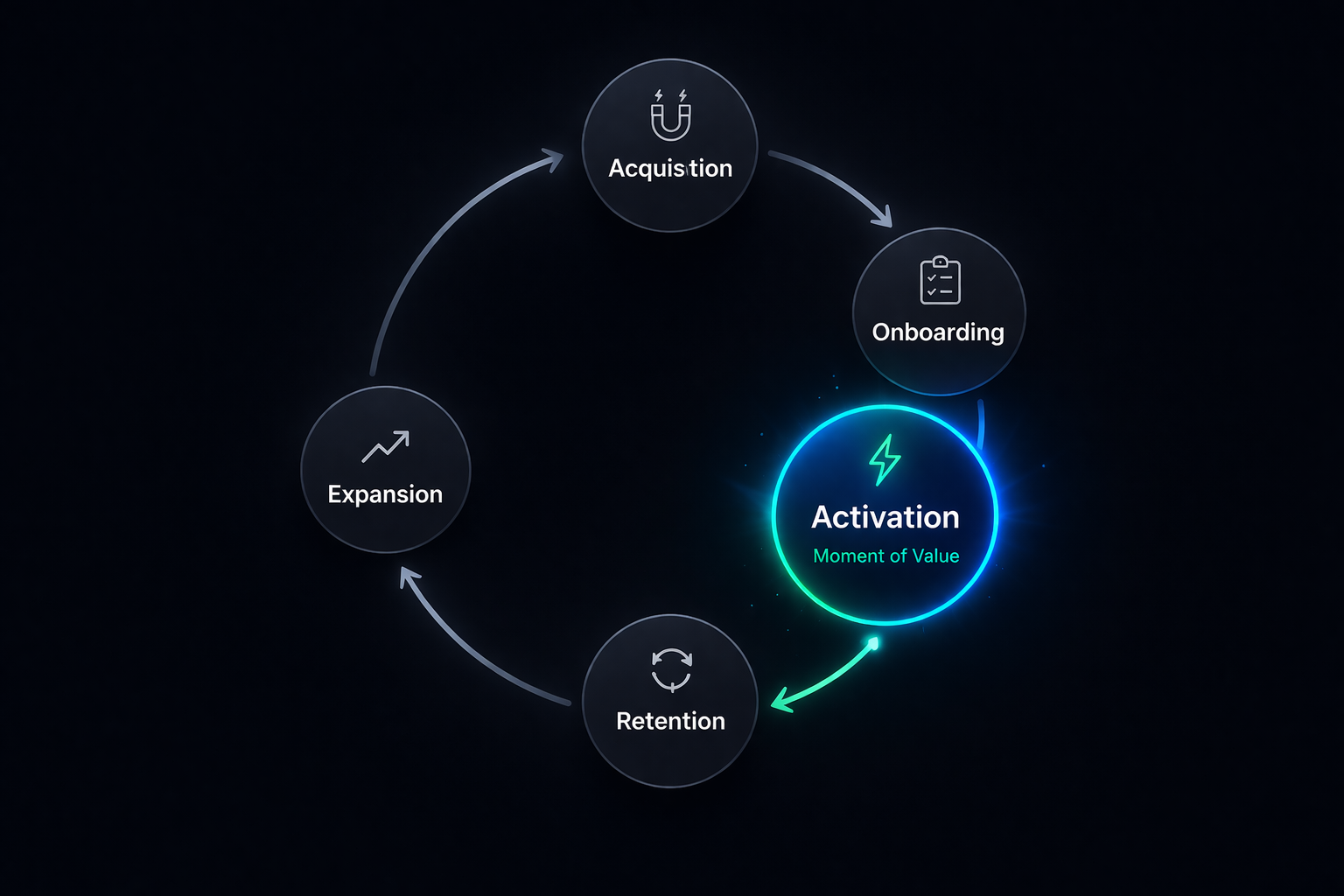
The Activation Metric That Should Exist
Replace generic activation metrics with:
Activation Rate = % of users reaching the activation event within a defined time window
Supporting metrics:
Time to Activation (TTA)
Drop-off before activation
Activation → retention conversion
This metric directly correlates with retention. Setup completion does not.
Activation Window
Activation must happen within a limited time frame.
Define acceptable window (e.g. first session, first 24 hours, first 3 sessions)
Users who do not reach activation within this window are unactivated
This is not churn yet. It is a system failure to deliver value early.
Redesigning Onboarding (Execution Model)
Onboarding must be built backward from activation.
Step 1 — Remove non-essential steps
Eliminate inputs not required for first value
Defer configuration
Step 2 — Accelerate time to output
Deliver usable output immediately
Avoid empty states
Step 3 — Reduce cognitive load
Single path flow
No branching decisions early
Step 4 — Automate wherever possible
Pre-fill data
Use templates
Simulate outputs if required
Step 5 — Guide contextually
Show next action only when required
Avoid full product education upfront
Before vs After System
Typical Flow
Signup
Profile setup
Configuration
Integration
Tutorial
First action
Correct Flow
Minimal input
Immediate output
Guided next step
Progressive completion
Failure Patterns to Eliminate
Long onboarding flows
Value gated behind integrations
Delayed output generation
Manual-heavy first experience
Generic activation definitions
Most A company that measures the wrong activation event will optimise toward it, celebrate it, hire toward it, and report it to investors — all while the product slowly loses the users who matter.
The teams that build products people love are not doing anything magical. They are just asking a more honest question: not "did the user get through our setup?" but "did the user experience the thing that makes leaving feel like a real loss?"
Answer that question. Build toward it. Measure it honestly.
That is what a real product activation metric for growth actually looks like.
Perspectives
“The goal of onboarding is not to teach users how to use the product. It is to get them to the moment where they don't want to leave.”
— Des Traynor, Co-founder, Intercom
“Most teams are measuring the moment users learned where the buttons are. The moment that actually matters is the one where they stop thinking about leaving.”
— Meet Patel, Venture Builder & Startup Operator
Frequently asked questions
What is the difference between onboarding completion and product activation?
Onboarding completion measures whether a user finished setup — a friction metric. Real product activation is when a user first experiences value they could not get anywhere else. Most dashboards track the first and call it the second. They are not the same event.
How do you find the real activation moment in your product?
Interview your best retained users and ask: "Tell me about the moment you knew this product was going to stay in your life." Ten interviews will reveal the same specific story. That story is your real activation event — engineer your onboarding toward it.
Why does improving onboarding completion not improve retention?
Because onboarding completion measures compliance — how easy it is to get through setup. Retention is driven by activation — whether users experienced genuine value. Optimising compliance without addressing value delivery produces better-looking dashboards and flat retention.
What metric should replace onboarding completion as an activation signal?
Time-to-moment — the percentage of new users who hit the real activation event within a defined window. This metric moves in lockstep with retention. Onboarding completion does not.
Sources
Written by Meet Patel — startup operator and growth strategist in Dubai.