The 10% Decision Framework: Control What Compounds
By Meet Patel · 2026-03-22 · 5 min read
Summary
The founder decision making framework uses a Decision Compounding Test: does this choice change the decisions available to you in the future? If yes, give it 90 minutes of focus. If no, decide in 60 seconds. Three categories matter: People, Direction, and Constraint decisions.
Key Metrics & Takeaways
- Knowledge workers make an average of 35,000 decisions per day — the vast majority habitual, not strategic
- Cornell University Food & Brand Lab Research
- Founders who protect structured thinking time report 3x better decision quality on high-stakes choices compared to those who decide reactively
- First Round Capital State of Startups Report, 2023
Founders process 50–100 decisions per day across product, hiring, customers, and capital.
A small subset reshapes the future decision space. The rest consumes cognitive bandwidth without altering trajectory.
This is a control failure. Decision quality is not distributed based on long-term impact.
The Core Variable
Behind decision volume, there is decision compounding.
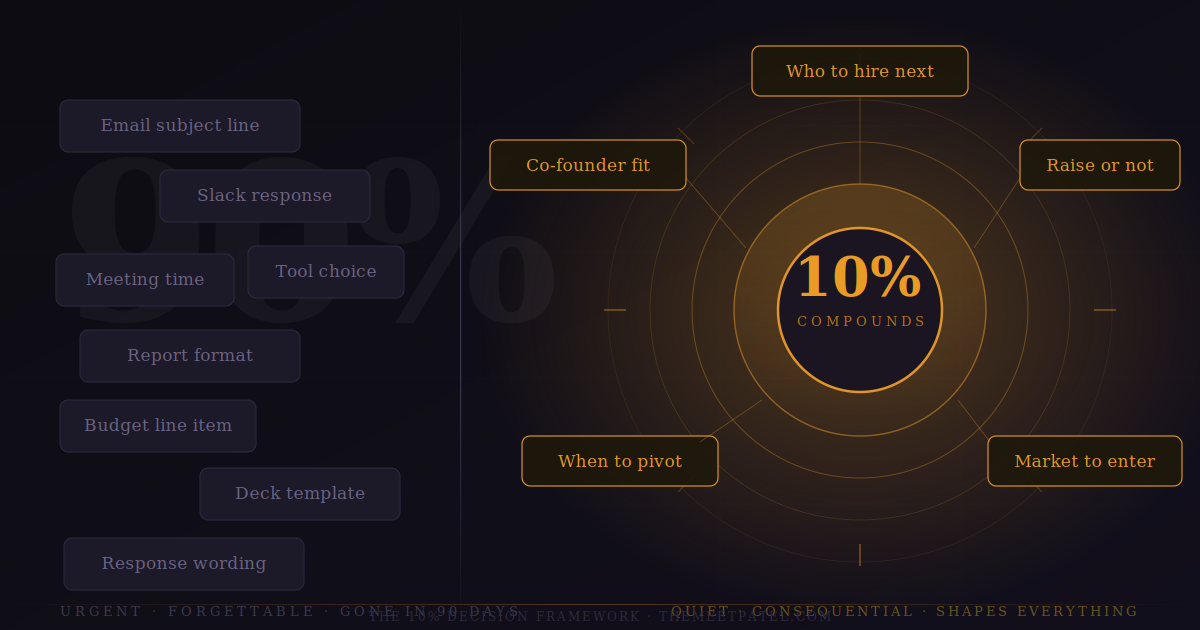
A compounding decision changes the set of decisions available after it is made. It alters trajectory, not just output.
This creates a simple classification system:
Decision Compounding Test
Does this decision expand or restrict future options?
Does it change trajectory, not just output?
If yes → 10% Decision.
If no → execution decision.
The math nobody wants to admit
A working founder makes somewhere between 50 and 100 decisions on a typical day.
How many of those will still be visibly shaping your company in five years?
Maybe seven. If you're being generous.
The other 90%? Gone. Not because they were made badly — but because they never had the potential to compound in the first place. You spent your best cognitive hours on decisions that resolved a situation and then disappeared.
"Most decisions should be made with around 70% of the information you wish you had. The key skill is knowing which decisions deserve that threshold at all." — Jeff Bezos, Amazon Shareholder Letter
The problem isn't making the wrong 10% decisions. The problem is treating the 90% like they're worth the same attention.
The System
Every decision must pass through a structured flow.
Input: All incoming decisions (internal + external triggers)
Classification: Apply Decision Compounding Test
Allocation: Assign time based on impact
Execution: Deep work for 10%, rapid closure for 90%
Control: Track allocation and outcomes
This converts decision-making from reactive activity into a controlled system.
Where Systems Break
Misallocation of attention creates predictable failure patterns.
Leadership: Time spent on low-impact decisions → strategic drift
Product: Feature-level focus → fragmented roadmap
Hiring: Delayed people decisions → execution bottlenecks
Capital: Reactive timing → loss of control
Each failure originates from ignoring compounding decisions.
The One Test That Changes Everything
Every founder decision making framework needs a single question you can run in seconds. Here's mine:
Does this decision change the decisions available to me in the future?
That's it. One question. Two outcomes.
If yes — this decision compounds forward. It deserves 90 minutes of uninterrupted thinking before you move.
If no — it resolves a situation and disappears. Decide it in 60 seconds. Move on. Do not revisit it.
Here's what that looks like in practice:
Decision | Compounding? | Time it deserves |
|---|---|---|
Hiring your first head of growth | ✓ Yes | 90 minutes minimum |
Which market to enter next | ✓ Yes | 90 minutes minimum |
Email subject line for tomorrow | ✗ No | 60 seconds |
Which tool to use for internal docs | ✗ No | 60 seconds |
Whether to raise your next round | ✓ Yes | Days of thinking |
Responding to a routine investor update | ✗ No | 10 minutes |
When I started applying this test at ZeroHuman, I discovered something uncomfortable: most of the decisions I was treating as important failed it immediately. Urgent, yes. Important-feeling, yes. Compounding, no.
The Three Decisions That Always Compound
Once you run the test consistently, patterns emerge. The decisions that always pass it fall into three categories.
1. People Decisions
Every person you bring into your orbit changes your access to information, energy, and opportunity.
A wrong junior hire can quietly define the culture of an entire department two years from now
A right advisor opens a market that would have taken you three years to access alone
A co-founder misalignment, left unaddressed, becomes a company-ending problem
When you choose someone, you're not just choosing them. You're choosing everything they carry with them — their network, their mental models, their habits, their relationships.
People decisions always compound. Always.
2. Direction Decisions
These are the choices that define your solution space for years:
Which market to enter (and which to walk away from)
Whether to raise capital or stay efficient
When to pivot versus when to stay the course
What to build next when you have real optionality
The hardest thing about direction decisions is they rarely feel urgent. There's no deadline. No one waiting on an answer. They sit quietly in the background — easy to defer, easy to make half-heartedly.
But deferring a direction decision doesn't delay it. It just means you'll make it under pressure, with worse information, when the moment forces your hand.
3. Constraint Decisions
This is the category most founders don't even recognise as decisions.
The customer segment you're walking away from
The feature your product will never have
The type of investor you're choosing not to take money from
The price point you're holding even when customers push back
Constraint decisions feel passive. They're actually some of the most active choices a company makes — because every constraint you set shapes the decisions your competitors have to make in response to you.
When you decide what you're not, you define what you are — with a precision that mission statements almost never achieve.
Where Founders Actually Go Wrong
The mistake isn't making bad 10% decisions. The mistake is this:
Urgent decisions arrive loudly. Important decisions arrive quietly.
A customer is angry. An investor wants a call. A team member is in conflict. These scream for attention — and founders respond because we're wired to respond to screaming. The screaming feels like importance. It almost never is.
The real compounding decisions? They sit in your thinking time. In conversations that seem premature. In strategic options that feel far off. No deadline. No urgency signal. So they get deferred.
And then suddenly you're making a direction decision in 48 hours because the market forced your hand — with none of the thinking time it deserved.
The founder decision making framework inverts this default. What's most important gets first access to your best hours. What's loudest gets handled — but quickly, without the cognitive resources that belong elsewhere.
Second-Order Impact
Every compounding decision creates downstream effects.
Hiring: Changes execution capacity and culture
Market: Changes customer type and sales motion
Constraints: Reduce optionality, increase clarity
Evaluation must include second- and third-order consequences.
Decision Velocity vs Quality
The system separates two modes:
10% Decisions: Optimize for quality
90% Decisions: Optimize for speed
Mixing both reduces performance.
The Real Competitive Advantage
You have access to the same capital markets, talent pools, and technology infrastructure as every other founder in your category.
What most of them don't have is a system for protecting the quality of their judgment for the decisions that actually compound.
The founder decision making framework isn't complicated. It's just disciplined.
One question. One morning ritual. One rule: your best hours go to decisions that change what becomes possible — not to the ones that just arrived loudest.
Start tomorrow morning. Identify the one decision that deserves your best thinking. Give it 90 minutes before anything else gets any of you.
That's a 10% Decision. Make it like one.
Decision quality compounds trajectory. Decision volume compounds noise.
By Meet Patel
Perspectives
“Most decisions should be made with around 70% of the information you wish you had. If you wait for 90%, in most cases, you're probably being slow.”
— Jeff Bezos, Founder, Amazon
“The founders I've watched build something real weren't faster decision-makers than everyone else. They were better at knowing which decisions deserved their best hours — and ruthless about protecting those hours from everything else.”
— Meet Patel, CEO, BiggVentures
Frequently asked questions
What is the founder decision making framework for high leverage choices?
The Decision Compounding Test — ask whether this decision changes the decisions available to you in the future. If yes, it deserves 90 minutes of deep focus. If no, decide in 60 seconds and move on. Only 10% of daily decisions pass this test.
What are the three categories of high leverage founder decisions?
People Decisions (who you bring in changes your access to information and opportunity), Direction Decisions (market, capital, pivot choices that define your solution space), and Constraint Decisions (what you choose not to do, which shapes competitors' responses).
Why do founders make poor decisions despite working hard every day?
Because urgent decisions arrive loudly and get attention, while important decisions arrive quietly and get deferred. The 10% that compound your trajectory rarely have deadlines — so founders make them under pressure with insufficient thinking time.
How do you apply the 10% decision framework every morning?
Before opening Slack or email, write the one decision most needing deep thinking today. Run the compounding test. If it passes, block 90 uninterrupted minutes for it. Handle everything else quickly using frameworks, defaults, or delegation.
Sources
Written by Meet Patel — startup operator and growth strategist in Dubai.