The Loneliness Tax Every Founder Pays
By Meet Patel · 2026-03-04 · updated 2026-03-05 · 2 min read
Summary
Founder loneliness is an invisible cost of building a company. As responsibility concentrates at the top, founders often lack safe spaces to share doubts, which slows decisions and drains belief.
Key Metrics & Takeaways
- 72% of founders report mental health challenges linked to isolation and pressure (Michael A. Freeman, UCSF study).
- 50% of entrepreneurs experience loneliness during company building (Startup Snapshot Report).
- Founders are 2× more likely to report depression compared to the general population
Building a company looks glamorous from the outside.
Headlines. Funding announcements. Big wins splashed across LinkedIn.
But there’s a silent cost no one writes about in the balance sheet: loneliness.
Every founder pays it. Sometimes in small installments. Sometimes in crushing lump sums.
The Real Cost Structure of a Founder
Every business has two ledgers:
Financial P&L: salaries, marketing, infra, growth.
Emotional P&L: doubt, courage, conviction, and the isolation of carrying it all.
Founders obsess over the first. Investors measure the first.
But the second ledger determines survival.
Because the true cost of leadership isn’t what you spend — it’s what you can’t share.
The Invisible Tax
Loneliness creeps in quietly and grows without warning.
It starts the moment you step out of the safety of being “one of the team.”
Suddenly you are the person everyone looks to — for answers, for payroll, for belief.
And then the questions begin to echo:
Who can I be vulnerable with?
Who can I tell that I don’t have it figured out?
Without a safe space:
Risks feel bigger than they are.
Decisions drag longer than they should.
Momentum in the team begins to thin.
Silence turns into isolation.
It becomes a flywheel — once it spins, it pulls everything down with it.
The Loneliness Flywheel
Loneliness has momentum. Once it starts, it builds on itself.
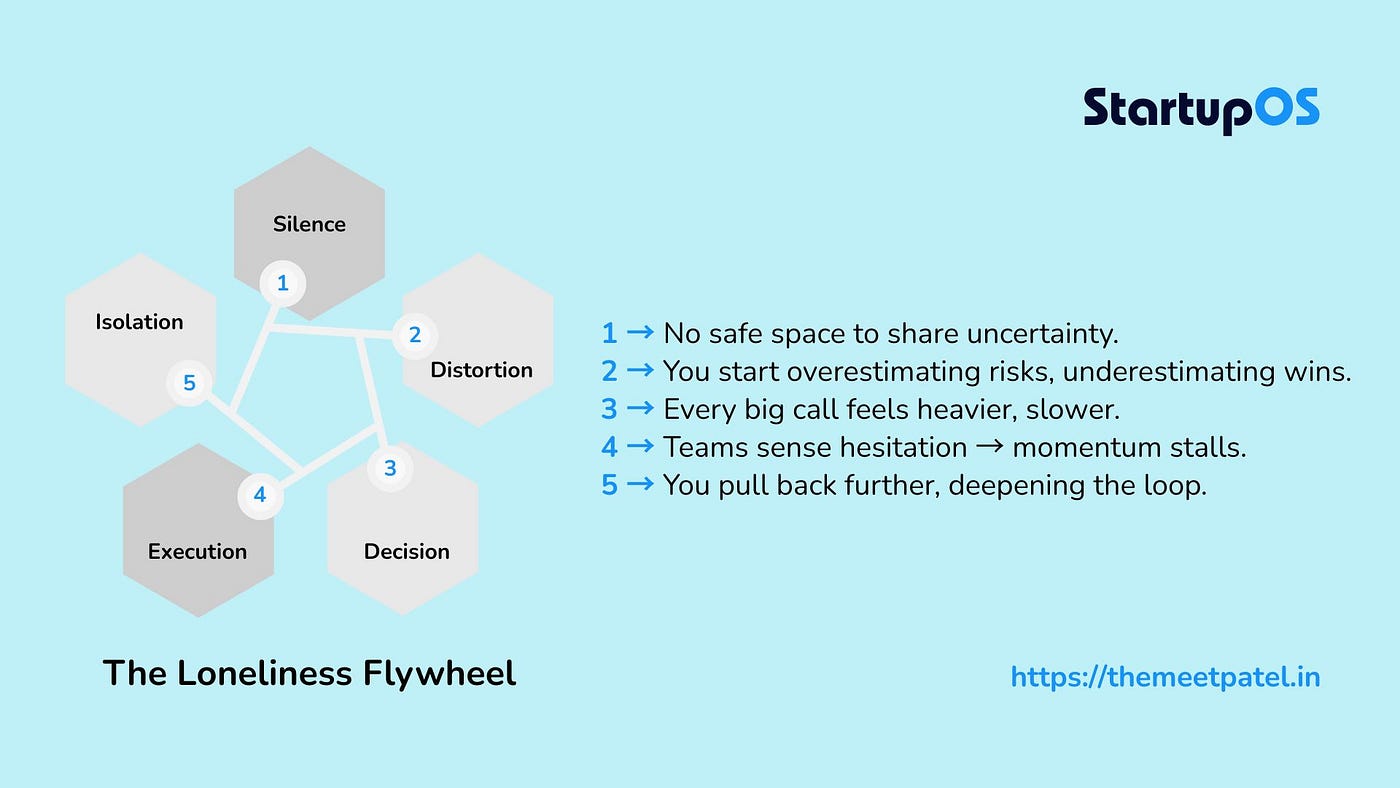
It begins with silence — no space to share the doubts that keep circling in your head.
Silence turns into distortion, where risks feel larger than they are and small wins lose their meaning.
Distortion slows decisions, every choice carrying extra weight.
Slow decisions bleed into execution, and the team begins to sense hesitation.
Hesitation feeds isolation, and the cycle closes in on itself.
When this flywheel spins long enough, the founder’s energy drains faster than the company’s capital.
Why It Hurts More Than Money
Capital can be raised again. Time can be managed. Talent can be replaced.
Belief is different.
When belief thins, courage becomes expensive. Decisions slow. The vision flickers.
And when belief fades, so does the company.
The Rebate Nobody Talks About
Loneliness begins to fade when founders find spaces built on trust.
A circle small enough to feel safe.
A conversation where no one is posturing.
Moments where a founder says, “I don’t have the answers right now,” and someone replies with understanding, not judgment.
Real connection lightens the silence. That’s where the refund starts.
The Refund Mechanism
Every founder needs buffers that make the load lighter. Smart founders build 3 buffers:
Founder Circles → Private, small, consistent groups where truth > optics.
Strategic Soundboards → Advisors who answer the question behind the question.
Personal OS → Decision architecture, mental models, and reflective rituals that reduce the weight of carrying everything alone.
They are part of building the company itself.
Every founder pays the loneliness tax. The smart ones build systems, communities, and circles that refund it.
-- Meet Patel
Perspectives
“Every founder pays the loneliness tax. The smart ones build systems, communities, and circles that refund it.”
— The Meet Patel, Founder of Biggventures
Frequently asked questions
Why do founders feel lonely?
Founders carry concentrated responsibility for decisions, team morale, and financial outcomes, which limits spaces where they can openly express uncertainty.
How does loneliness affect startup performance?
Isolation slows decision-making, distorts risk perception, and weakens leadership energy, which impacts execution and team confidence.
What helps founders overcome loneliness?
Structured founder circles, trusted advisors, and personal decision frameworks provide safe environments for reflection and clearer thinking.
Written by Meet Patel — startup operator and growth strategist in Dubai.